.png)
Autonomous AI Newsletter System
From raw web signals to a ready-to-send HTML campaign. A multi-agent system that scrapes real-world travel data, enforces strict brand guardrails, and autonomously generates editorial content for the Gear for Good audience.
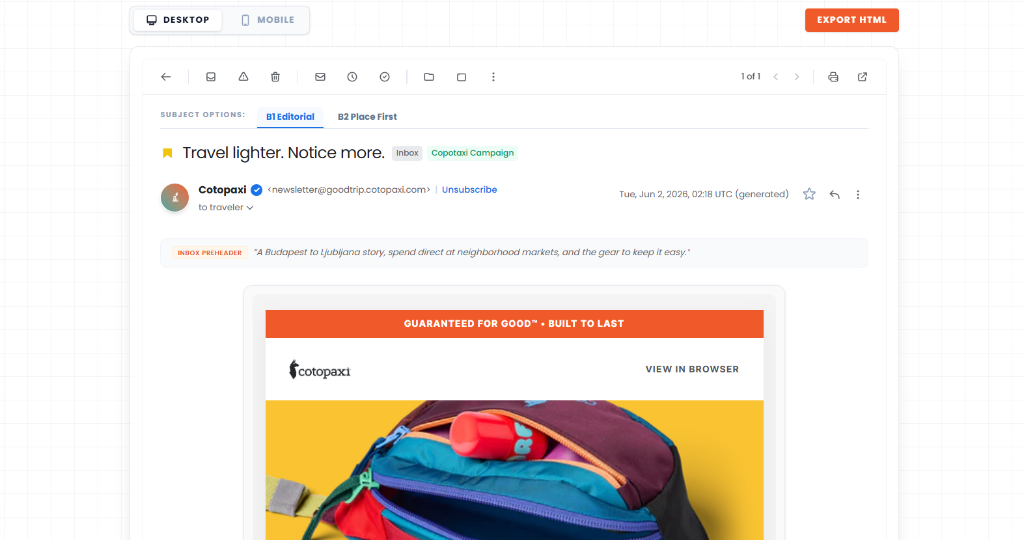
This is a self-initiated project by product designer and AI builder Itamar Katan: a multi-agent AI system that turns live web signals into on-brand, ready-to-send newsletter campaigns.
Build a newsletter engine that feels like an editorial team.
Cotopaxi is not a generic outdoor brand. The product experience has to feel warm, useful, colorful, and grounded in purposeful adventure, while avoiding unsupported impact claims or sales-heavy copy.
The Product Problem
Marketing teams need campaigns that respond to real travel conversations, seasonal needs, reviews, and product fit. The challenge is making that process fast without flattening the brand into generic AI copy.
The system treats every issue as a small editorial package: one travel idea, one useful packing angle, one grounded do-good note, and a product grid that belongs in the story.
The Architecture Principle: Separation of Concerns
We designed the platform as an autonomous editorial room using strict prompt chaining. Instead of one massive, fragile prompt, we deployed five specialized agents. Each agent owns a micro-task, outputting validated JSON schemas to the next, ensuring a transparent QA trail and preventing generic "AI-speak" from reaching the final HTML.
A specialized multi-agent architecture.
The engine separates research, strategy, writing, content QA, and email building so each step can be improved independently without losing the end-to-end flow.
- Signal Miner: Scrapes live trends and product reviews via Apify actors, extracting raw sentiment data.
- Strategist: Analyzes signals against Cotopaxi's brand memory to formulate a campaign JSON spec (angle, tone, target product).
- Writer: Constrained by strict few-shot prompting to draft short, specific editorial copy—expressly forbidden from using generic ecommerce jargon.
- Content QA: An independent evaluator agent that scores the draft against a 'Greenwashing & Safety' matrix, triggering automatic rewrites if claims are unsupported.
- Builder and QA: Compiles the approved text and dynamic product inventory into responsive HTML, performing a final heuristic check for mobile rendering.
Config-driven audience pipelines.
We built the core engine to be entirely agnostic to the target audience. Instead of hardcoding logic, the pipeline is config-driven. Marketers simply inject a metadata JSON file (defining cadence, tone rules, and product constraints).
This spins up entirely new campaigns—whether for Casual Weekenders or Alpine Adventurers—without altering the underlying agent architecture.
- Casual Weekenders: Optimistic tone, versatile travel packs, cozy layers, and light road-trip guides.
- Alpine Adventurers: Technical shell reviews, weather-aware layering, durable packs, and trail planning.
- Global Nomads: Transit cubes, modular organization, and urban-to-trail gear for longer movement.
Built for orchestration, speed, and iteration.
The implementation leans on proven web and AI infrastructure so the product can move from a demo into a maintainable SaaS-style workflow.
- Antigravity and Codex: Agentic reasoning for planning, implementation, and iteration across the product surface.
- Next.js on Vercel: Utilizing serverless functions for API orchestration and streaming UI to expose real-time agent reasoning traces to the frontend.
- Firebase: Serves as the persistent state layer, logging agent handoffs, campaign histories, and audience configurations for easy rollback and auditing.
- Apify: Scheduled web-scraping actors for Reddit threads, reviews, and social travel signals.
The newsletter agent, clearly.
What is this project?
A multi-agent AI system that goes from raw web signals to a ready-to-send HTML newsletter campaign, with brand guardrails built in. It is a self-learned project, not a real client.
How is the system structured?
Five specialized agents - Signal Miner, Strategist, Writer, Content QA, and Builder and QA - each own one step and pass validated JSON to the next.
How does it avoid generic AI copy?
The Writer works under strict few-shot prompts that ban generic e-commerce jargon, and an independent QA agent scores each draft for unsupported or greenwashing claims and triggers rewrites.
Can it serve different audiences?
Yes. The pipeline is config-driven: a metadata file sets cadence, tone rules and product constraints, so new audiences start without changing the agents.
What is it built with?
Next.js on Vercel, Firebase for state and audit logs, Apify for scheduled scraping, and Antigravity and Codex for agentic planning and implementation.